

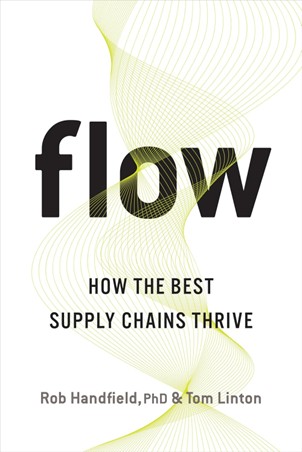
by Rob Handfield Phd (Author), Tom Linton (Author)
Flow: Rethinking Supply Chains for a World of Constant Disruption
As supply chain disruptions become a regular topic in the media and an
everyday reality for businesses and consumers alike, Flow offers
a timely framework for understanding and fixing the delays and bottlenecks
that plague global supply chains.
Written by Rob Handfield and Tom Linton, the book introduces the concept
of flow as a foundational principle for modern supply chain management.
Drawing inspiration from the physical world, flow reflects the movement
of electricity, materials, and even time itself.
What Flow Means in Supply Chains
In the context of process optimization, flow represents the seamless
integration of end-to-end supply chains. It emphasizes reducing friction,
eliminating unnecessary delays, and creating systems that move smoothly
from sourcing to delivery.
Achieving flow also requires rethinking where supply chains are anchored.
The book highlights the growing importance of nearshoring and onshoring,
as organizations reassess the risks of highly fragmented global supply
bases in an era of disruption.
Applying Physics to Global Trade
One of the book’s most distinctive contributions is its application of
physical laws to supply chain design. Handfield and Linton explore how
principles such as momentum, friction, and constraints can explain
real-world supply chain behavior.
By combining predictive strategies, global event sequencing, and data
exchanged through smart technologies, the authors show how companies can
anticipate disruption rather than simply react to it.
Policy, Strategy, and Supply Chain Design
Flow examines how supply chain physics influence critical business
and policy decisions, including tariffs, factory location, outsourcing,
pandemic response, and the geographic distribution of supply bases.
These insights help explain why traditional efficiency-focused strategies
often fail under stress, and why resilience and adaptability must become
central design principles.
Lessons from Real Companies
The authors provide concrete recommendations for improving supply chain
flows, supported by real-world examples. Case studies from companies such
as Biogen, General Motors, Siemens, and Flex illustrate how different
organizations responded to the disruptions caused by COVID-19.
These examples demonstrate how applying flow-based thinking can lead to
faster recovery, greater visibility, and stronger long-term performance.
Why Flow Matters
Flow is not only a resource for procurement and supply chain
professionals. It is a practical guide for any manager concerned with
enterprise-level success in an increasingly unpredictable world.
By reframing supply chains as dynamic systems governed by universal
principles, the book offers a clear path toward more resilient, responsive,
and competitive organizations.